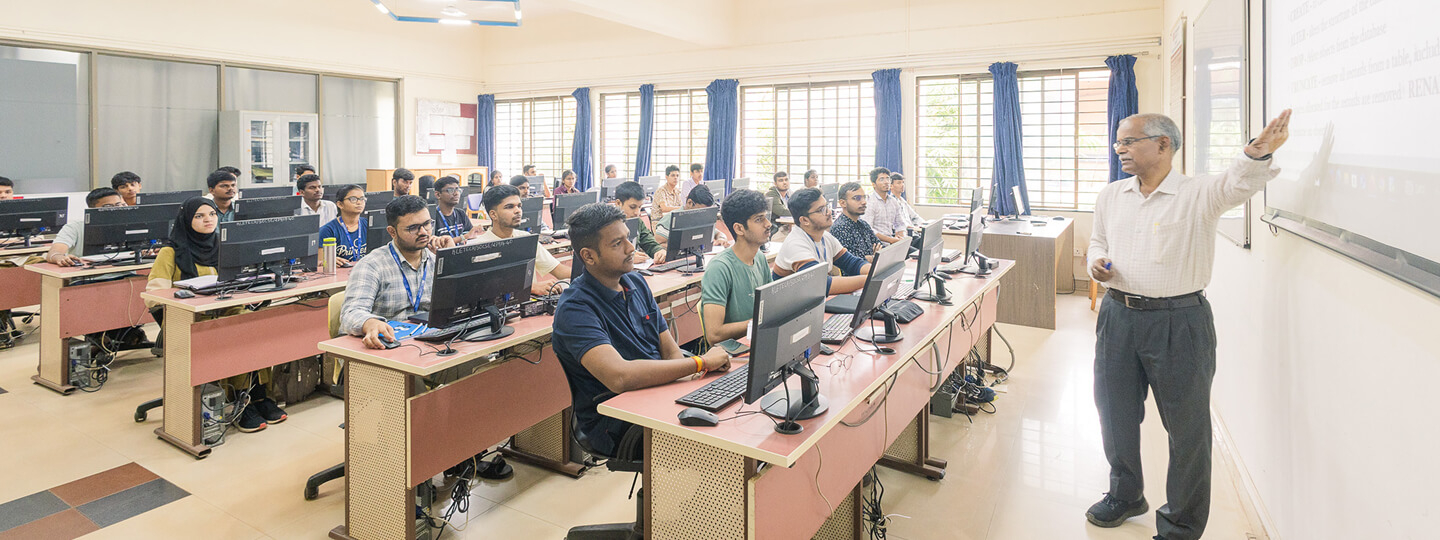
Our Bachelor of Computer Applications (BCA) program is a 3-year, full-time undergraduate course that equips students with strong foundational skills in computing. From programming and data structures to databases, networking, and web/mobile development, we ensure a comprehensive and hands-on learning experience from the start.
As students progress, they dive into advanced and emerging areas like Big Data Analytics, Cloud Computing, IoT, Cyber Security, and Artificial Intelligence. With every concept reinforced through practical labs and real-world projects, we prepare our graduates to confidently step into the tech industry or pursue higher studies in specialized computing domains.
Have a strong foundation and ability to apply knowledge of Computer Science, Mathematics, and Humanities to conceive, analyse, design, and implement IT solutions to problems in real-life applications.
Have a comprehensive background to practice Software Engineering Principles in a variety of domains that require software architecture, design, development, and testing practices.
Understand the professional and ethical obligations of a software engineer towards society and the need for lifelong learning.
Have an ability to effectively participate in multi-disciplinary teams using ICT effectively.
Apply knowledge of computing fundamentals, computing specialization, mathematics, and domain knowledge appropriate for the computing specialization to the abstraction and conceptualization of computing models from defined problems and requirements.
Identify, formulate research literature, and solve complex computing problems, reaching substantiated conclusions using fundamental principles of mathematics, computing sciences, and relevant domain disciplines.
Design and evaluate solutions for complex computing problems, and design and evaluate systems, components, or processes that meet specified needs with appropriate consideration for public health and safety, cultural, societal, and environmental considerations.
Use research-based knowledge and research methods, including design of experiments, analysis and interpretation of data, and synthesis of the information to provide valid conclusions.
Create, select, adapt, and apply appropriate techniques, resources, and modern computing tools to complex computing activities, with an understanding of the limitations.
Understand and commit to professional ethics and cyber regulations, responsibilities, and norms of professional computing practice.
Recognize the need, and have the ability, to engage in independent learning for continual development as a computing professional.
Demonstrate knowledge and understanding of the computing and management principles and apply these to one’s work as a member and leader in a team, to manage projects and in multidisciplinary environments.
Communicate effectively with the computing community, and with society at large, about complex computing activities by being able to comprehend and write effective reports, design documentation, make effective presentations and give and understand instructions clearly.
Understand and assess societal, environmental, health, safety, legal, and cultural issues within local and global contexts and the consequential responsibilities relevant to professional computing practice.
Function effectively as an individual and as a member or leader in diverse teams and multi-disciplinary environments.
Identify a timely opportunity and use of innovation to pursue that opportunity to create value and wealth for the betterment of the individual and society at large.
An ability and capacity acquired through deliberate, systematic, and sustained effort to carry out complex IT activities involving innovative ideas, technical skills, and interpersonal skills.
Apply computing concepts, skills, and processes to produce a product/project in the domain, demonstrating professional knowledge and attitude.
|
No
|
Programme Components
|
|---|---|
|
01
|
Humanities and Social Sciences
|
|
02
|
Basic Sciences
|
|
03
|
Professional Core + Skill Set
|
|
04
|
Program Electives
|
|
05
|
Minor Projects
|
|
06
|
Internship training, Internship Project
|